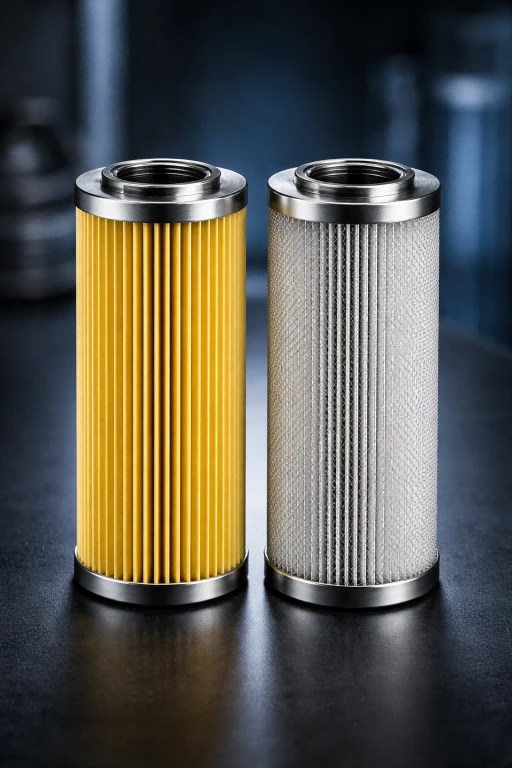
Did you know that up to 80% of all hydraulic system failures are directly caused by fluid contamination? In modern industrial applications, where servo valves operate with microscopic clearances and system pressures frequently exceed 300 bar, standard contamination control is no longer enough.
When engineers and maintenance managers look to optimize their MRO (Maintenance, Repair, and Operations) budgets and extend equipment lifespan, the first component they evaluate is the hydraulic filter element.
The most common debate in fluid purification is choosing the right filtration material: Microglass vs. Cellulose filter media. In this technical guide, the engineering team at Xinxiang Saya Filters Co.,Ltd (AYATER) breaks down the science behind these two materials to help you make an informed decision for your hydraulic circuits.
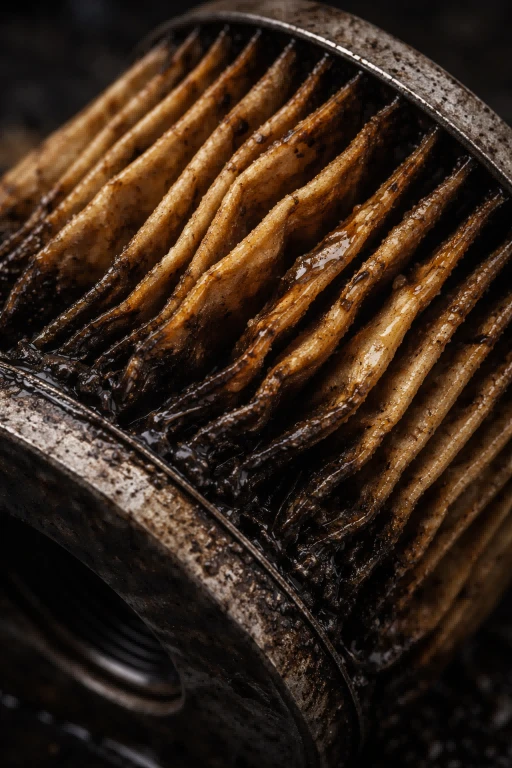
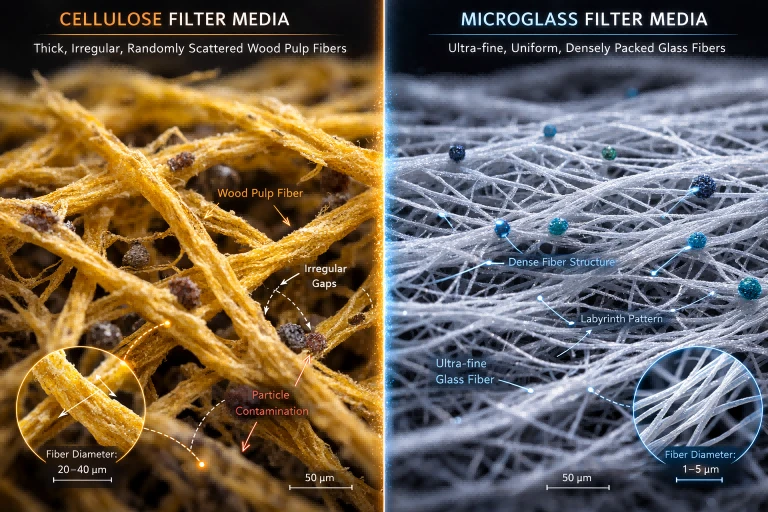
Cellulose filter media is essentially highly refined industrial paper made from wood pulp fibers. For decades, it has been the standard for basic fluid filtration.
How it works: Cellulose relies on nominal filtration. Because wood fibers are naturally irregular in shape and size, the pores within the filter paper are inconsistent. A "10-micron" cellulose filter might capture most 10-micron particles, but larger particles can still slip through the larger, irregular gaps.
The Drawbacks:
Lower Efficiency: The irregular pore structure leads to a lower Beta Ratio.
Moisture Absorption: Cellulose naturally absorbs water from hydraulic fluid. When the fibers absorb water, they swell. This swelling restricts fluid flow, dramatically increasing the pressure drop (Δp) and causing the filter to go into premature bypass mode.
Shorter Lifespan: With lower Dirt Holding Capacity (DHC), cellulose elements require frequent replacements.
Best for: Low-pressure applications, basic lubrication systems, or older machinery where extreme fluid cleanliness is not a critical requirement.
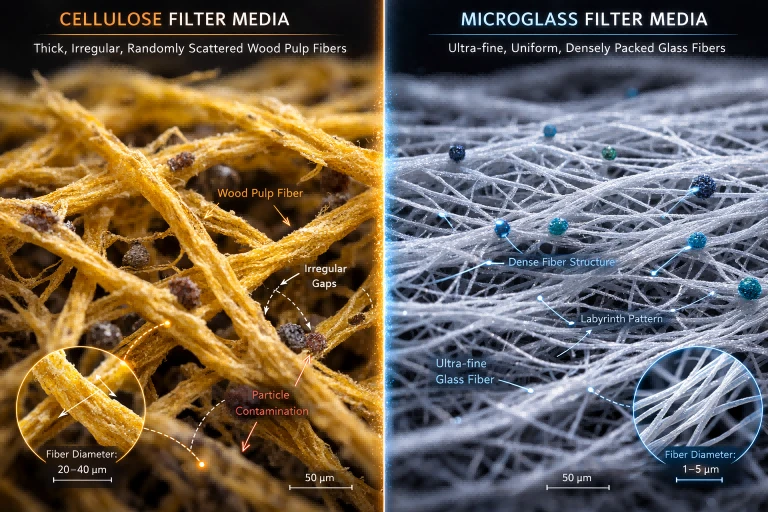
Microglass (or fiberglass) media represents a significant leap in filtration technology. It is manufactured using incredibly fine, inorganic glass fibers bonded together with a synthetic resin.
How it works: Microglass provides absolute filtration. The manufacturing process allows for precise control over fiber thickness and distribution, creating a highly uniform, labyrinth-like pore structure.
The Engineering Advantages:
Exceptional Beta Ratio: High-quality microglass elements routinely achieve a Beta Ratio of ßx(c) ≥ 1000, meaning they capture 99.9% of targeted particles.
Maximum Dirt Holding Capacity (DHC): Because the glass fibers are much thinner than wood fibers, there is more open void space within the media. This allows the filter to trap and hold significantly more contamination before the pressure drop reaches a critical level.
Water and Chemical Resistance: Inorganic glass fibers do not absorb moisture. They maintain their structural integrity even in the presence of water, high operating temperatures, and aggressive synthetic fluids.
Best for: High-pressure hydraulic systems, proportional and servo valve protection, turbine lubrication, and any application requiring maximum uptime.
To make the best engineering choice, let's look at the direct comparison matrix:
| Feature | Cellulose Media (Paper) | Microglass Media (Fiberglass) |
| Filtration Rating | Nominal (Approximate) | Absolute (Precise) |
| Pore Structure | Irregular and random | Uniform and engineered |
| Dirt Holding Capacity | Low to Moderate | Extremely High (Up to 4x more) |
| Beta Ratio (Efficiency) | Low (Typically ß < 75) | High (Typically ß ≥ 1000) |
| Water Resistance | Poor (Fibers swell and restrict flow) | Excellent (No swelling) |
| Initial Purchase Cost | Lower | Higher |
| Total Cost of Ownership | High (Frequent replacements, machine wear) | Lowest (Long lifespan, protects system) |
While microglass clearly wins in performance, not all microglass filters are manufactured equally. Under high differential pressures, poorly constructed fiberglass media can tear or collapse, releasing a massive wave of captured dirt directly into your hydraulic system.
At Xinxiang Saya Filters Co.,Ltd, we engineer our replacement filter elements to exceed OEM standards. Here is how we ensure ultimate reliability:
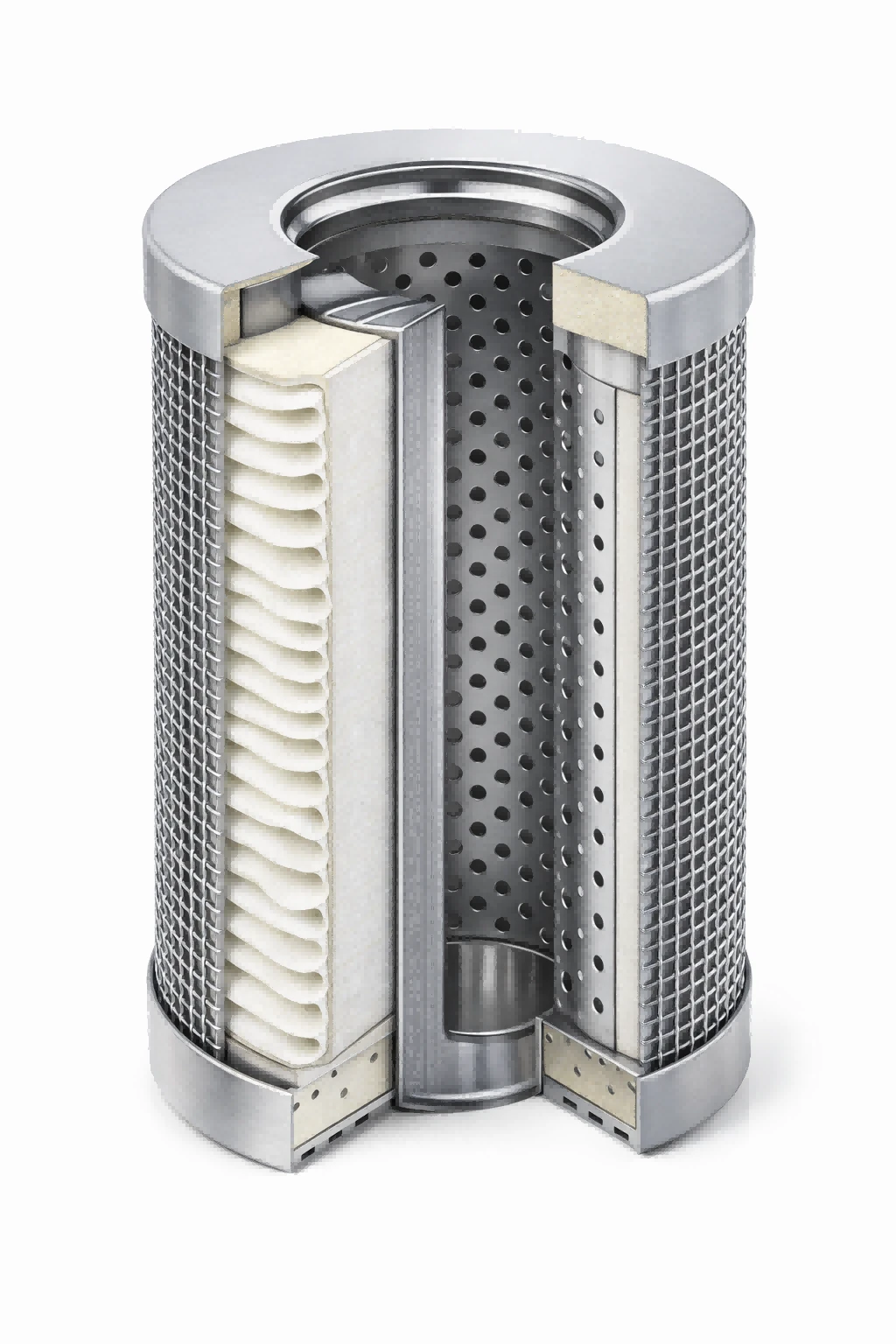
Multi-Layered Structure: We utilize up to six distinct layers in our pleated elements. This includes pre-filtration layers to catch large debris, the core absolute microglass layer, and structural support layers.
Stainless Steel Support Mesh: Our microglass media is sandwiched between rugged stainless steel or epoxy-coated wire mesh. This ensures the pleats remain perfectly spaced and prevents the media from collapsing or channeling under severe pressure pulsations (compliant with ISO 2941 collapse resistance standards).
Advanced Epoxy Potting: The filter media is deeply embedded into the metallic end caps using industrial-grade epoxy adhesives, guaranteeing zero fluid bypass.
While cellulose filters may seem cheaper initially, the hidden costs of frequent replacements, high maintenance labor, and premature pump or valve wear will rapidly inflate your MRO expenses. Upgrading to high-efficiency microglass filter elements is the most cost-effective way to achieve extended fluid life and uncompromised machine reliability.
Ready to upgrade your hydraulic filtration system?
Do not let poor contamination control slow down your production. If you are currently using standard cellulose filters or paying premium prices for big-brand OEM microglass elements, we have a solution.
Provide us with your current filter part numbers, operating pressure, and fluid type. The engineering team at Xinxiang Saya Filters Co.,Ltd (AYATER) is ready to offer a free technical cross-reference and a competitive quote for our high-performance replacement elements.
👉 [Contact Us Today for a Free Technical Evaluation and Quote]


