
Products Description The amine filter element is engineered specifically for the purification of amine solvents used in gas sweetening processes, removes 99.98% of particulate contaminants ≥5 μm. Its unique structure and tailored chemistry make it ideal for applications involving...


The amine filter element is engineered specifically for the purification of amine solvents used in gas sweetening processes, removes 99.98% of particulate contaminants ≥5 μm. Its unique structure and tailored chemistry make it ideal for applications involving monoethanolamine (MEA) solutions, CO₂ capture systems, and high-temperature drilling fluids.
Amine filtration typically uses a combination of precision and adsorption elements to protect downstream equipment and ensure process stability. Precision elements (e.g., Polypropylene cartridges, string-wound cotton cartridges) remove particles as small as 1-10 μm, while adsorbent media (activated carbon cartridges) remove surface-active contaminants and degradation by-products.

String-Wound Cotton Cartridge Filters
These depth cartridges-made of surfactant-free, virgin cotton-are the most economical, with nominal ratings between 5–10 μm. They deform under pressure, shedding fines, and typically handle 0.25–2 gpm/ft² of external surface. Change-outs may be labor-intensive in larger systems.

Proprietary Polypropylene Cartridge Filters
Extruded-polymer cartridges maintain dimensional stability under differential pressure. Their graded or uniform structures yield higher dirt-holding capacities and "absolute" ratings. Radial-pleated designs can provide up to 33 ft² of media per ft² of external surface, boosting throughput.

Activated Carbon Filter Elements
Hard, steam-activated carbons (8×30 mesh) are used on 10–20% slipstreams at 2–4 gpm/ft² flux to remove foaming agents, amine degradation products and hydrocarbons. Bed life is typically 6–12 months; coarser carbons (5×7, 4×10 mesh) can handle full-flow filtration at up to 10 gpm/ft².
| Parameter | Typical Value / Description |
| Filtration Rating (Solids) | 10 µm absolute |
| Solids Carryover | ≤ 1 ppm by weight of suspended solids in circulating amine |
| Efficiency | 99% @ 25–40 µm (pleated polypropylene microfiber) |
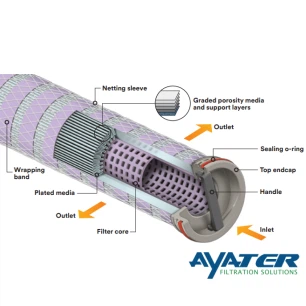
| Filter Media | Graded‐porosity depth media combining mechanical entrapment and surface wetting |
| Flow Direction | Inside-out (to protect pleats, maximize dirt holding, and enable surface filtration) |
| End‐Cap & Core Materials | End caps: inert polymers or metal |
| Operating Temperature | Up to ~150 °C (element media and seals selected for thermal stability in hot amine) |
| Operating Pressure | Typically up to the housing rating (150–300 psi); cartridge ΔP limited to ≤ 35 psi |
| Element Dimensions | Customized on demand |
High-efficiency adsorption materials
Amine-based active ingredients (liquid/solid amines) with high surface area porous carriers (e.g., molecular sieves, activated carbon) ensure highly selective adsorption of acid gases (CO₂, H₂S).
Intelligent structural design
Porous layered structure (microporous/mesoporous) combined with modular packaging balances high adsorption efficiency with low pressure drop and supports quick replacement.


Regeneration and Durability
Recyclable regeneration (heating/pressure reduction), high temperature resistance (150°C+), corrosion and gas impurity contamination resistance, extended service life.
Application customization
Amine filter elements are customized according to gas composition (concentration, humidity), adapted to industrial scenarios (e.g., natural gas desulfurization, biogas purification), and meet the needs of low-cost operation and maintenance.

Q: What is the lifespan of the Amine Filter Element?
A: Typically 6–12 months, depending on operating conditions.
Q: Can it handle acidic environments?
A: Yes, with optional acid-resistant coatings (e.g., SO/ZrO₂).
Q: Do you provide sample testing?
A: Free samples available for qualified clients.
Hot Tags: amine filter element, China, manufacturers, suppliers, factory, customized


